
Today
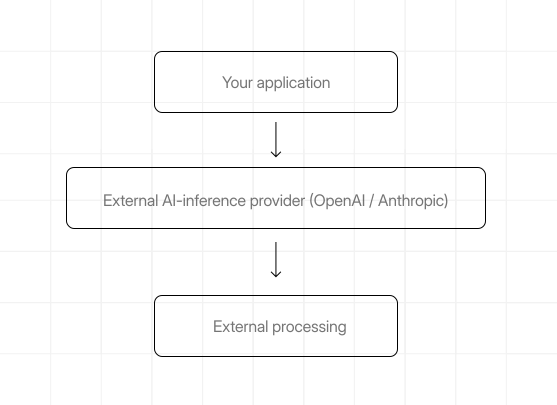
- Variable token costs
- Vendor dependency
- Limited control
Replace OpenAI, Anthropic and other external LLM APIs with open models running in your own cloud, VPC or infrastructure — without rebuilding your applications.
Problem framing
Most enterprise AI applications are built on infrastructure the company does not control.
Running an open model locally solves the ownership and security problem — but often introduces another one: the model is no longer capable enough for production workloads. Logos is designed to close that gap.
Before / After
With Agentica Logos, your existing AI applications can connect to private models through the same interfaces they already use.
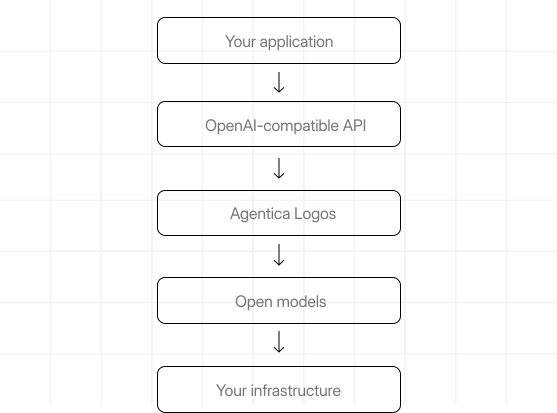
Own the models. Own the data. Own the inference.
Use case
Logos exposes an API compatible with industry standards so existing applications can migrate without any rewrite.
Change the endpoint. Keep your application. Move the intelligence inside your infrastructure.
Platform layers
Hosting an open-source model is becoming a commodity. Making private AI good enough for real enterprise work is not. Logos combines three layers into one enterprise inference platform.
A unified interface between your applications and AI infrastructure.
Production infrastructure for serving open models.
The proprietary intelligence layer that determines how the model approaches the task, not only which model answers it.
Tezeus provides persistent cognitive scaffolding around the underlying language model: structured reasoning protocols, verification mechanisms and domain-specific cognitive configurations.
The underlying model remains replaceable. The intelligence layer stays yours.
Tezeus
Large language models provide raw capability. Tezeus structures that capability for enterprise work. Instead of relying only on increasingly long prompts and fixed instructions, Tezeus introduces persistent reasoning structures around the model.
Define how the system should approach a task. An auditor evaluates information differently from a researcher; a compliance officer applies different standards from a customer-service agent.
The model plans before acting, evaluates assumptions and adapts its approach when evidence changes.
Multiple reasoning perspectives can challenge conclusions and identify inconsistencies before an answer reaches the user.
Configure how AI should reason within a specific business environment without retraining the underlying foundation model.
The result is a model-independent intelligence layer that can sit on top of the open model best suited to your organisation.
Routing tiers
Not every task needs expensive reasoning. Logos can route workloads according to complexity, latency and quality requirements.
Optimised for speed and cost.
Enhanced reasoning for everyday enterprise workloads.
Maximum verification and reasoning.
Let Logos decide.
The runtime evaluates the request and selects the appropriate model, reasoning strategy and compute profile automatically.
Use expensive intelligence where it matters. Use efficient inference everywhere else.
Internal benchmark
Buying more computational power is not always the answer. The performance of an AI system is determined not only by the size of the model, but by the architecture surrounding it.
In Agentica's internal testing, adding Tezeus to the same model running on the same hardware improved completion of complex multi-step tasks while reducing dead ends, execution time and output-token usage.
29%40%
task completion
600s250s
median completion time
53%13%
abandoned tasks
2062% ↓
abandoned tasks
Same model weights. Same hardware. Different intelligence layer.
Deployment
The same Logos API can run across multiple infrastructure models — from managed European infrastructure to fully sovereign environments inside your organisation.
Dedicated European inference operated for you. Best for teams that want to move away from external AI providers quickly without managing their own GPU infrastructure.
Inference on Poland’s national cloud, operated for you. Best for public-sector and regulated organisations that need their data to stay under Polish jurisdiction.
Single-tenant infrastructure dedicated to your organisation. Predictable performance, isolated compute, stronger control.
Deploy inside your VPC, private cloud, data centre or air-gapped environment. Designed for organisations with strict requirements around data residency, confidentiality, regulatory compliance, IP, vendor risk, auditability.
One API. The deployment model you choose. Start in the cloud. Move to dedicated. Deploy locally when required.
Model independence
Avoid rebuilding your AI stack every time a better model appears. Logos separates applications from the underlying model. Your workloads can run across models from ecosystems such as:
Models can be replaced, benchmarked and upgraded while the interface used by your applications remains stable. This turns the foundation model into an interchangeable component rather than a strategic dependency.
Economics
Cloud AI is easy to start with — but difficult to budget at scale. With external APIs, cost grows with every token, every user and every workflow.
| External APIs | Agentica Logos |
|---|---|
| Cost increases with usage | Infrastructure cost can be planned in advance |
| Pricing controlled by the provider | Marginal inference cost falls as utilisation improves |
| Difficult to forecast as adoption grows | Compute can be shared across multiple applications |
| Every additional token adds cost | Workloads can be routed to the most cost-efficient model |
| Switching models may change unit economics overnight | Capacity can be sized around actual business demand |
| High usage can create unexpectedly large bills | Cost is no longer directly tied to third-party token pricing |
Logos changes the economics from consumption-based AI to infrastructure-based AI. Instead of paying a third party for every request, you run inference on capacity you control.
From variable API bills to predictable capacity.
Intelligence routing
Unit economics
Flexible model
Logos lets you choose the economic model that fits your organisation:
You can start with managed capacity and move toward dedicated or owned infrastructure as usage grows. The API remains the same. The economics become progressively more controllable.
Predictable capacity. Transparent economics. No dependency on third-party token pricing.
Logos Benchmark
Give us a representative sample of your current AI workload. We evaluate: current provider performance, open-model alternatives, model + Tezeus configurations, task success rate, latency, GPU utilisation, token usage, expected infrastructure cost.
| Configuration | Performance | Cost | Privacy |
|---|---|---|---|
| External frontier model | High | Per-token, variable | Data leaves your organisation |
| Open model | Medium | Low | Private |
| Open model + Tezeus | Higher | Low / predictable | Private |
| Logos Auto | Quality-optimised | Optimised | Private |
The result is a migration map showing which workloads can move to private infrastructure today — and which should remain on frontier APIs.
Benchmark your workloadUse cases
Logos is designed for organisations moving AI from experimentation into core business processes.
Give autonomous workflows a private inference layer without depending on third-party frontier APIs.
Analyse sensitive contracts, case materials and proprietary documents without sending them outside controlled infrastructure.
Run internal AI workflows with stronger control over data residency, logging and model access.
Embed language-model intelligence into internal applications while maintaining infrastructure ownership.
Provide employees with company-controlled AI instead of exposing sensitive information to multiple external tools.
Replace variable API economics with infrastructure that becomes more predictable as usage scales.
Developer experience
Sovereignty should not mean making AI harder to use. Logos gives infrastructure and security teams control while developers continue using familiar APIs.
Positioning
Foundation models are improving rapidly. The best model today may not be the best model six months from now. Agentica Logos is designed around that reality.
Applications connect to Logos. Logos selects and operates the models. Tezeus provides the proprietary intelligence layer above them.
This allows organisations to continuously improve their AI infrastructure without rebuilding the applications that depend on it.
FAQ
No. Logos is the platform that serves open models inside your infrastructure and adds Tezeus, an intelligence layer above them. The models are interchangeable; the platform and the intelligence layer stay.
Tezeus is Agentica's intelligence layer: persistent reasoning structures around the model — identity, reasoning protocols, verification and domain configuration — that shape how it works, not only what it answers.
In most cases, no. Logos exposes OpenAI-compatible endpoints, so an application moves by changing its endpoint and credentials rather than its code.
As managed EU cloud, on Chmura Krajowa, on dedicated single-tenant infrastructure, or inside your own VPC, private cloud, data centre or air-gapped environment.
Yes. Logos runs open-weight models from ecosystems such as Qwen, Llama, Mistral, DeepSeek and Gemma, including fine-tuned versions of your own.
No. Tezeus works around the model, not inside it. The weights stay as they are, so the model can be replaced or upgraded without losing the intelligence layer.
For many workloads, yes. A benchmark on a sample of your real tasks shows which can move to private infrastructure today and which should stay on frontier APIs for now.
You can serve a model with vLLM. Logos adds what production needs around it: a compatible API gateway, access control, routing, monitoring, audit logs — and Tezeus, which is what makes a smaller open model good enough for the work.

Move away from external AI APIs without sacrificing intelligence. Agentica Logos gives enterprises private, controllable AI infrastructure with compatible APIs, enterprise governance, and proprietary intelligence for production workloads.